Translate

space

Sunday, January 26, 2014

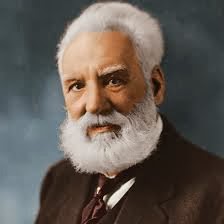
Alexander Graham Bell

Alexander Graham Bell

Only few people in this world leave their footprints on the sands of history, and these men of honor never die. One such grand personality is the greatest innovator of all times Mr. Alexander Graham Bell, who invented the first practical telephone. His other major inventions include: optical communications, hydrofoils, metal detector and aeronautic.


Graham bell was born in Edinburgh, Scotland on March 3, 1847. He was the only child, of Professor Alexander Melville Bell, out of the three, who didn’t die due to tuberculosis at a young age. He received his early education at home from his father; however he then got admitted to Royal high School, Edinburgh, which he left at the age of 15, due to poor performance.

Bell moved to London to live with his grand father and enrolled at the Western House Academy, Scotland. For further studies he joined University of Edinburgh. His first invention came at the age of 12, when he built a homemade de-husking machine to be used at his neighbor’s mill. In return, he was given a small workshop within the mill which he used to carry out further experiments.
At the age of 23, Bell’s brother’s widow and his parents shifted to Canada, to stay with a family friend. After a short stay there, they purchased a farm near Brantford, where Bell built his own workshop in the carriage house. After setting up his workshop, Bell continued his experiments with electricity and sound based on the work of Helmholtz.


Telephone
By 1874, telegraph message traffic was rapidly expanding; there was a great need to find an inexpensive way to send multiple telegraph messages on each telegraph line.
At that time, Bell had made great progress at both his Boston laboratory as well as at his family home in Canada and his work on harmonic telegraph entered a decisive stage. Bell got financial support from two wealthy patrons but he did not have the basic knowledge to continue with the experiment. He still he did not give up and kept trying.
Bell hired Thomas A. Watson, an experienced electrical designer, as his assistant. In 1875, an accident during the experiment led to the sound powered telephone, which was able to transmit voice like sounds. At last, after the patent issue made by Elisha Gray on March 10, 1876, Bell succeeded in making his telephone work.
The Bell Telephone Company was created in 1877. Bell company engineers brought about numerous improvements to the telephone making it the most successful product ever.
Bell further carried out his experiments in communication. He came up with the photophone-transmission of sound on a beam of light, which was a precursor of fiber-optics. He helped the deaf to learn new speech techniques. Altogether he received 18 patents in his name out of which he shared 12 with his collegues.
Final years:


On August 2, 1922 Bell died of diabetes at Beinn Bhreagh, Nova Scotia, at age 75, leaving behind a wife and two daughters. He was buried at the Beinn Bhreagh Mountain.
During his funeral every phone in North America was silenced in honor of the great inventor.


Friday, January 24, 2014

Alexander Fleming


Scottish biologist and inventor Alexander Firming is widely regarded for his 1928 discovery of penicillin, a drug that is used to kill harmful bacteria. His work on immunology, bacteriology, and chemotherapy is considered groundbreaking and highly influential.


Born in Ayrshire, Scotland on August 6, 1881 to Hugh Fleming and Grace Stirling Morton, Alexander Fleming was the third of the four children. He attended medical school in London, England and graduated in 1906. Fleming assisted in battlefield hospitals in France during World War I (1911-1918), where he observed that some soldiers, despite surviving their initial battlefield wounds, were dying of septicemia or some another infection only after a few years.


Contributions and Achievements:

Once the war was over, Fleming looked for medicines that would heal infections. The antiseptics of World War I were not totally efficient, and they primarily worked on a wound’s surface. Spraying an antiseptic made things even worse if the wound was deep.
Fleming came back to his laboratory in 1928 after a long vacation. He carried out an experiment and left several dishes with several bacteria cultures growing in them. After some time, he observed that some of the dishes were contaminated with a fungus, which ruined his experiment. He was about to discard the dishes, but he noticed that in one dish, the bacteria failed to grow in an area around the fungus.

He successfully isolated the fungus and established it was from the Penicillium group or genus. Fleming made his discovery public in 1929, however to a mixed reaction. While a few doctors thought penicillin, the antibiotic obtained from the Penicillium fungus, might have some importance as a topical antiseptic, the others were skeptical. Fleming was sure that the penicillin could also function inside the body. He performed some experiments to demonstrate that the genus of fungus had germ-killing power, even when it was diluted 800 times. Fleming tried to cultivate penicillin until 1940, but it was hard to grow, and isolating the germ-killing agent was even harder. He was unsure if it would ever work in a proper manner.

Luckily, a German Chemist, Ernst Chain, discovered the process to isolate and concentrate the germ-killing agent in penicillin some time later. Another Australian pharmacologist Howard Florey found out the ways of its mass production. During World War I, the goverments of U.S. and Great Britain funded Florey and Chain, therefore the penicillin almost became the magic spell that cured many diseases. Florey and Chain were awarded the Nobel Prize in 1945.


Personal Life and Death:

Fleming married his first wife, Sarah, who died in 1949. Their only child, Robert Fleming, went on to become a general medical practitioner. Fleming married for the second time to Dr. Amalia Koutsouri-Vourekas, with whom he worked at St. Mary’s, on 9 April 1953. She also died in 1986.

Fleming died of a heart failure in London in 1955.